
Crushing Poverty and the Hope of RSWR
In May 2011, RSWR field staff, Samson Ababu, and I (Program Director, Cindi Goslee) were driving along a roadway in Kenya having just completed several visits with RSWR project partners over the past week. It had been a wonderful trip with many strong women doing very good work. We had walked through small towns, chatting with young men preening by their motorcycles for hire, greeting children who followed us and meeting with our project partner group members at their vegetable stalls or stores. We had visited with women as they displayed and described numerous income-generating projects. We had also conducted a symposium with over 100 women project partners in which they shared their accomplishments and struggles. It was a joyous drive in which we stopped to admire a mama and baby baboon along the roadside and to laugh with a group of young men washing their motorbikes in a natural spring.
As we rounded a bend in the road, we saw a young boy sitting atop a pile of stones on the roadside. Samson stopped the car and we walked over to the child who was 7 or 8 years old. The little boy had a small pick hammer with which he was breaking the stones into smaller pieces. He was preparing the broken gravel for construction use to sell to lorry (truck) drivers along the roadway. As Samson took the child’s hammer to give stone crushing a try, a boy a bit older (perhaps 9 or 10) walked up. He was the younger boy’s brother.
Samson asked the boys why thy were not in school. The smaller child replied that they had no money for school uniforms, books or fees. When asked if they had eaten that morning, he said they had not. As the children’s mother appeared from the village below, Samson returned the hammer to the child, exclaiming that stone crushing was a very hard job.
He and I dug in our pockets for some cash and I into my backpack for a some almonds. Cash in hand, the mom left to purchase some maize for breakfast and the children munched on the almonds. Samson and I drove on with an even deeper appreciation of the work of the groups we had just visited. With the determination and hard work of the group members and with RSWR’s grant, those women’s children were able to go to school with breakfast in their bellies that day.
We also drove with a heaviness of heart for the family we had just met and the knowledge of children in Kenya (and around the world) whose families cannot afford to feed and send them to school. My prayer is with those thousands of children with no food in their bellies, no means to attend school and the requirement to do back breaking work to help their families. It is also with the efforts of RSWR and other organizations who are working to bring forth economic justice in this world of enormous economic disparity and injustice.
Using Financing for Change
My name is Silviano Valdez and I am a sophomore at Earlham College and a Bonner Scholar intern at Right Sharing of World Resources. I spent this summer with ThinkImpact, a program that teaches graduate and undergraduate students about social entrepreneurship in rural parts of Africa. With a colleague from ThinkImpact I started social business called Vuwa (water in Swahili) Enterprise in a small eastern Kenyan village. The project was heavily influenced by what I have learned interning with Right Sharing of World Resources. As in micro-finance, Vuwa Enterprise is able to make its service and products affordable through financing.
Vuwa Enterprise installs water catchments and storage systems on tin roof houses in areas subject to drought. For $20 Vuwa is able to install a 10-foot gutter system and 100-liter storage tank, and can educate a family about the prevention of waterborne diseases. In eastern Kenya women sometimes spend their whole day walking miles, carrying 20 liter jugs of water on their heads. When I was in the village of Chanagande the nearest wells ran dry twice, and the women had to walk even further. I wrote in my journal, “ I don’t know what is worse, seeing these women’s tired faces, or knowing that the water they were working so hard to take back to their families could causes diseases like typhoid or cholera.”
Vuwa’s rain catchments system and the Water Diseases Prevention Training helps families overcome these social challenges. However $20 is too expensive for Kenyans, who are living in poverty, unless the product is financed over 6 months. Therefore, we established a repayment plan and revolving loan system. After the installation of our product, a loan officer picks up a customer’s small weekly payment. In addition, the loan officer will provide a 6-month supply of Waterguard, and teach families how to use this water treatment which prevents waterborne diseases. The idea is that a family will continue to use this locally accessible treatment after our training and will be able to witness the change in their health.
Right Sharing of World Resources helped me realize the power of affordable financing for the poor. Even the poorest or the poor can afford to pay off a loan over a period of time. Instead of financing products, Right Sharing of World Resources helps finance women’s loans to start micro businesses. These businesses empower women, and tackle poverty by increasing income. This is possible because of people who are willing to take a chance on lending to the poor, who have been traditionally been perceived as too risky an investment. Right Sharing of World Resources has been committed to changing this view for the past 30 years and believes that economic empowerment of the poor through micro-credit has enormous potential to create positive social change.
I feel that Vuwa Enterprise is building off the model of Right Sharing Of World Resources. By giving the poor the ability to obtain credit they will increase access to tools to tackle social issues that effect their lives, such as access to healthy water supplies. Vuwa Enterprise’s model has taught me that the change-makers can use this model not only to help solve issues of water, but other types of global development issues. Hopefully as time goes by we will see more and more social business and non-profits using creative financing as tool a to overcome some of the greatest challenges that our generation faces today.
Right Sharing Partners in India
Floriculture training
More floriculture training
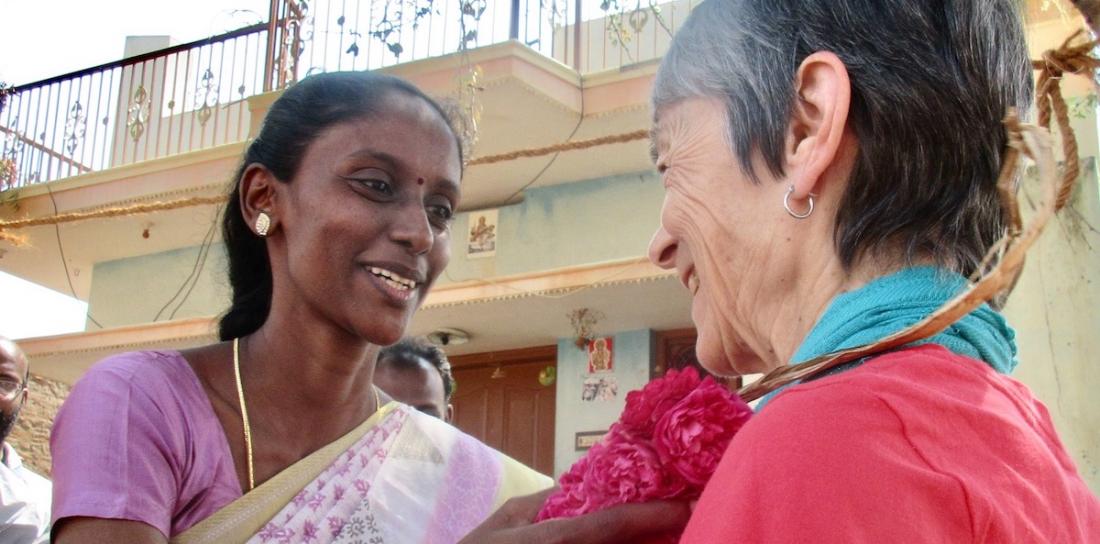
Here are some more photos from Right Sharing of World Resources beneficiaries in South India who received training and support for beginning micro-enterprises in floriculture amongst other projects. (Read more on this group here.) The first two photos show the women—a group of 25 (and growing)—at a four day training. The second two pictures show two of the women, amongst their crops.
The Sermon on the Mount
Matthew 5:1 Seeing the crowds, he went up on the mountain, and when he sat down, his disciples came to him.
The Beatitudes
2 And he opened his mouth and taught them, saying:
3 “Blessed are the poor in spirit, for theirs is the kingdom of heaven.
4 “Blessed are those who mourn, for they shall be comforted.
5 “Blessed are the meek, for they shall inherit the earth.
6 “Blessed are those who hunger and thirst for righteousness, for they shall be satisfied.
7 “Blessed are the merciful, for they shall receive mercy.
8 “Blessed are the pure in heart, for they shall see God.
9 “Blessed are the peacemakers, for they shall be called sons of God.
10 “Blessed are those who are persecuted for righteousness’ sake, for theirs is the kingdom of heaven.
11 “Blessed are you when others revile you and persecute you and utter all kinds of evil against you falsely on my account. 12 Rejoice and be glad, for your reward is great in heaven, for so they persecuted the prophets who were before you.
Salt and Light
13 “You are the salt of the earth, but if salt has lost its taste, how shall its saltiness be restored? It is no longer good for anything except to be thrown out and trampled under people’s feet.
14 “You are the light of the world. A city set on a hill cannot be hidden. 15 Nor do people light a lamp and put it under a basket, but on a stand, and it gives light to all in the house.
This woman is a member of “Kihila Avalina Vakali” another self-help group
This women is a member of “Kihila Avalina Vakali”—another self-help group sponsored by Right Sharing of World Resources. Centered in Western Kenya, the entrepreneurial project they have taken on is poultry-raising. To learn more about our projects, visit: http://www.rswr.org/Projects.php
Ugali is one of the staple foods in East Africa where we center a large percentage of our m
Ugali is one of the staple foods in East Africa where we center a large percentage of our microfinance projects. So today, we bring you a short video about the making of this delicious cultural dish.
Sandy Davis, Friend and former Kenyan transplant writes:
The main staple food is ugali (pronounced “00-golly”) which is only water and maize flour. Cooks in Western Kenya do not have measuring cups or spoons so they guess at proportions needed. For the ugali, heat a certain amount of water in a large kettle over the fire. The amount depends on how many people they will feed. When it boils, enough maize flour is added to absorb all the water and make a solid “cake” of ugali. It is then turned out of the rounded bottom of the pan onto a plate after being packed down hard. It is then a mound on the plate. Each person uses the communal knife to cut off a hunk of it for themselves. Portions are pinched off with the fingers and molded and packed in the hand with a final indentation made with the thumb to form a spoon. This is used to spoon up the greens or other broth and meat.
Ugali is a yummy, chewy meal that compliments most anything. If you give it a try at home, send us your pictures: media@rswr.org


